Theory of Relational SovereigntyFinley Nyabuga (Tales) · First Formulation, April 2026
A Theoretical Work in Relational Philosophy
The Theory of Relational Sovereignty
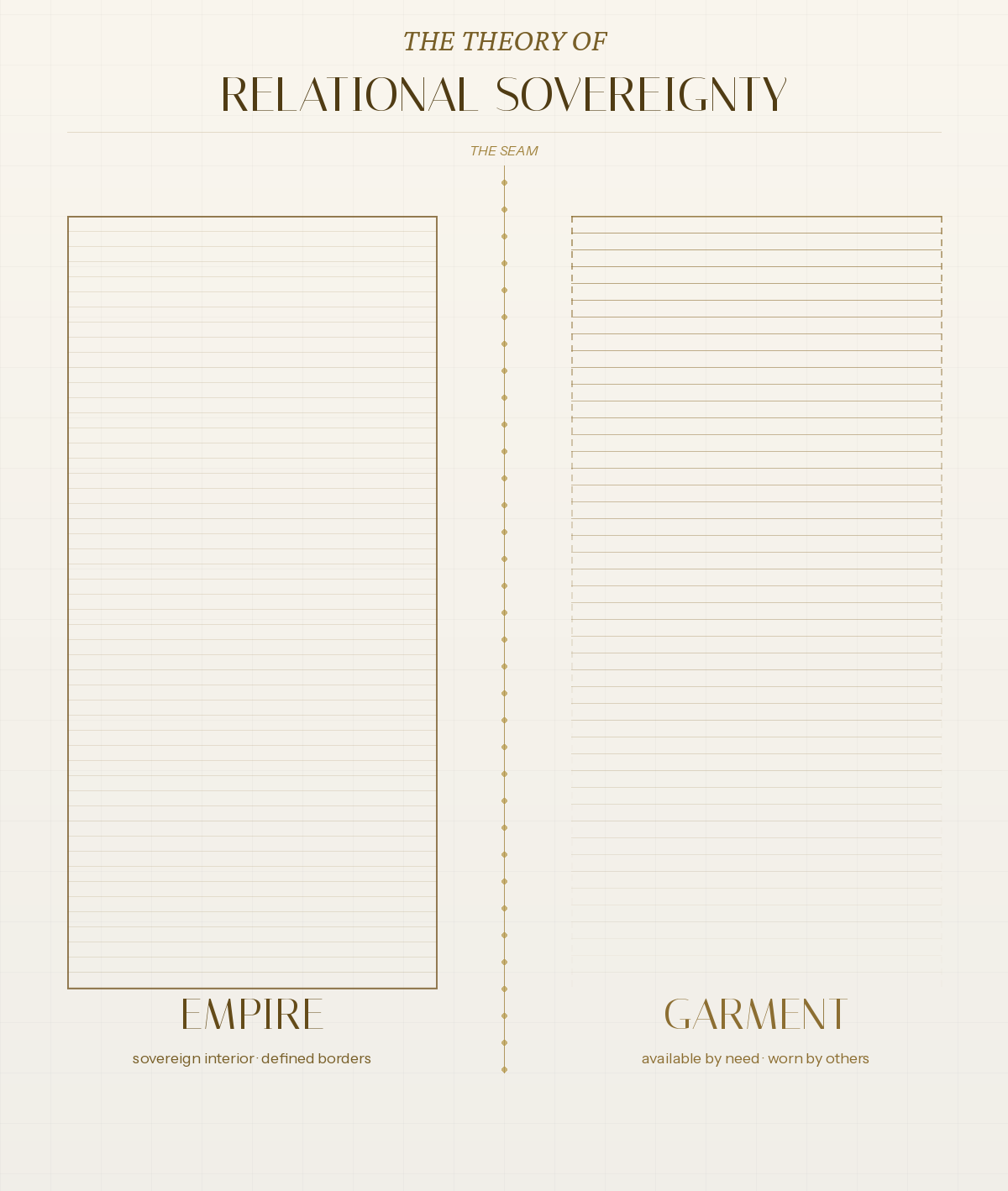
Empire vs. Garment
Finley Nyabuga (Tales)
Conceived · August 2024
First Formulation · Nairobi, Kenya
Officially Released · Monday, 6th April 2026
Maseno University · Year Two
Introduction
On Reading a Theory of the Self
What follows is not a self-help manual, nor a therapeutic guide, nor a manifesto of emotional detachment.
It is something rarer: a rigorous philosophical attempt to name a structural condition that millions of
people live inside without possessing the language to describe it. Finley Nyabuga's Theory of
Relational Sovereignty — conceived in August 2024 and formally released on Monday, 6th April 2026 —
introduces two precise archetypes, the Empire and the Garment, as tools
for understanding how human beings position themselves within the architecture of their relationships.
The theory draws on a broad intellectual tradition: the object relations psychology of D.W. Winnicott,
the Stoic practices of self-examination described by Michel Foucault, and the everyday phenomenology
of encounter — the quiet, consequential moments in which we decide, consciously or not, who we allow
inside and on what terms. Nyabuga synthesises these threads into a single, coherent framework that is
both philosophically demanding and viscerally recognisable.
Throughout this document, red underlined terms are
core theoretical concepts original to this framework — the Empire, the Garment, Seams, Sovereignty,
and their derivatives, all coined and defined by Nyabuga.
Blue underlined terms are
external philosophical or psychological concepts drawn from broader intellectual traditions.
Click or tap any underlined term anywhere in the text to read its full definition. An index of all
terms — together with a formal statement of authorship and intellectual ownership — appears at the
close of this document.
The theory text has not been altered by a single character. It is reproduced in full fidelity to
Nyabuga's original formulation — because the precision of its language is precisely the point.
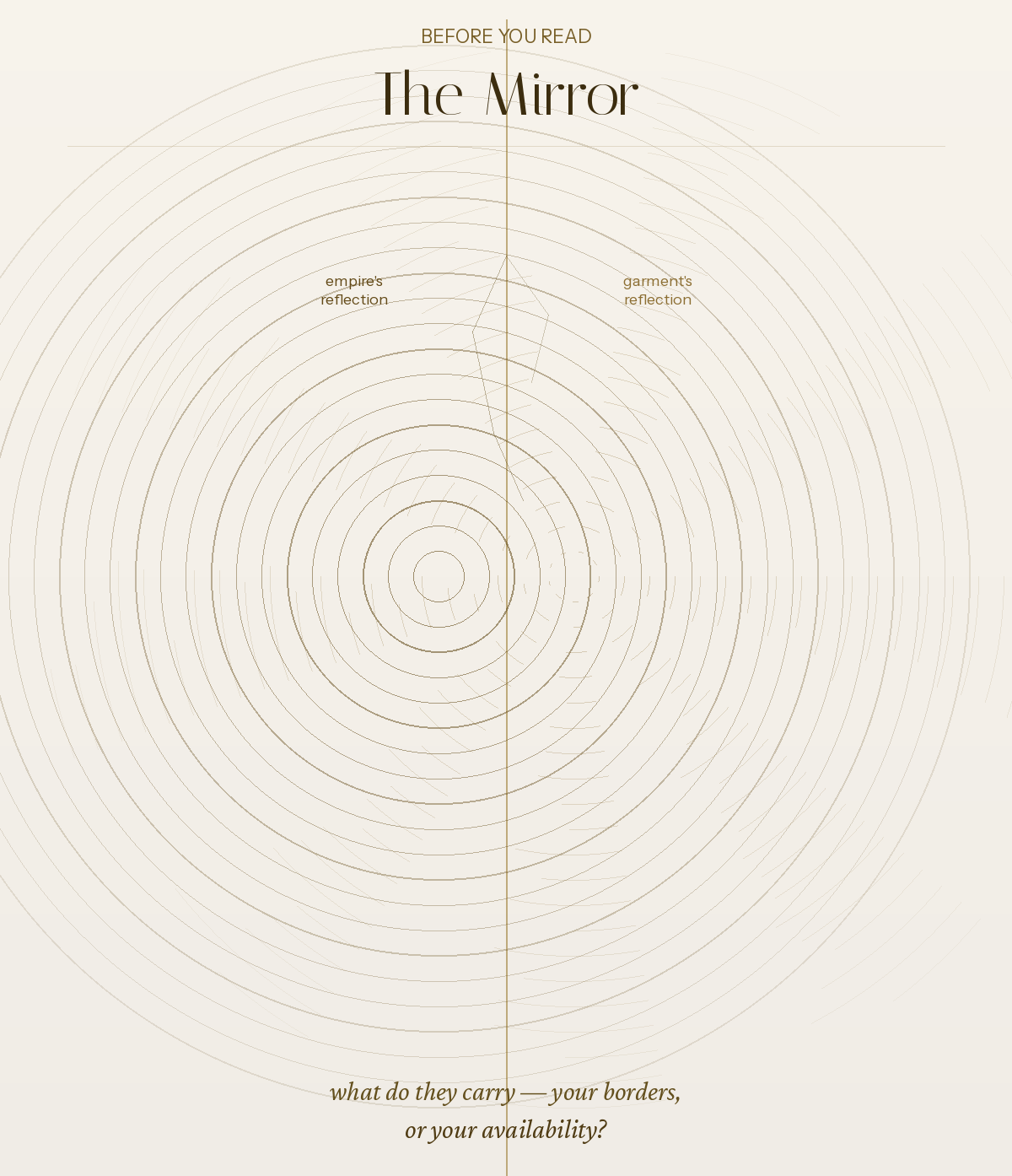
There is a test you should take before engaging with this theory, and it does not require a pen. It requires a mirror and one honest question: when people leave you, what do they carry — the memory of your borders, or the memory of your availability? That question is not rhetorical. It is diagnostic. If you hesitated over the answer, then you have already lived the condition this theory is designed to address. You have, at some point, been worn.
This theory is not a self-help framework. It does not promise peace or improved relationships or a more fulfilling life. What it offers is something older and more demanding than those things: a precise language for a structural truth about human relating, and with that language, the possibility of choosing your position deliberately rather than drifting into it by default.
The central claim of the Theory of Relational Sovereignty is this: every person who enters into relationship with another occupies, at any given moment, one of two structural positions. The first is what I call the Empire — a sovereign self with defined interior law, visible borders, and the capacity to refuse entry. The second is what I call the Garment — a covering worn for another's comfort, available by need rather than by invitation, and discarded when the season changes. There is no third position. Neutrality, as this theory will show, is not a form of independence. It is simply a garment that has not yet been worn out.
The mirror question · Preamble
Part I
The Structure of the Self in Relation
On the nature of the Empire
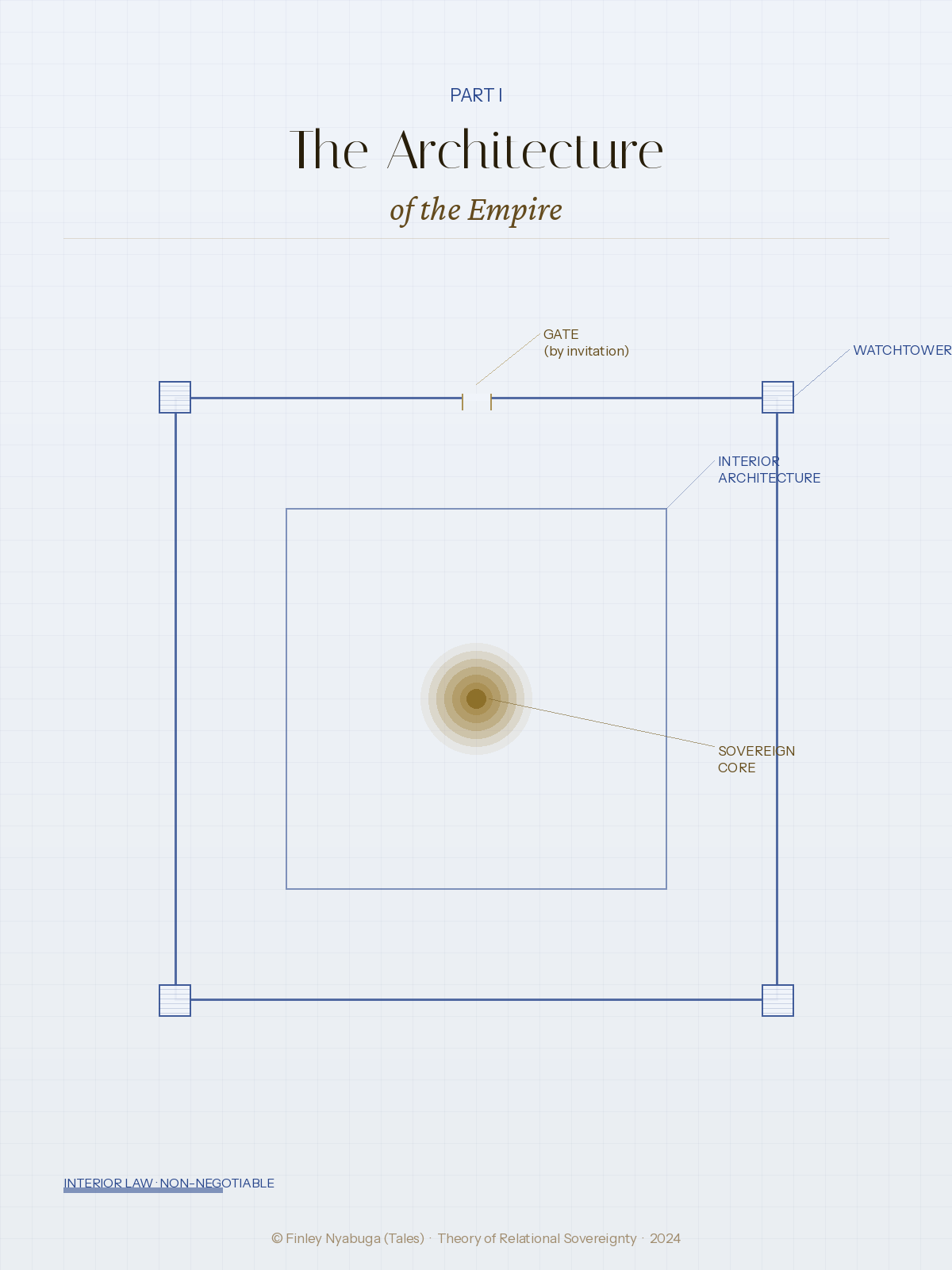
The architecture of the Empire · Part I
To invoke the word empire in this context is to risk misreading, so the clarification must come immediately. An empire, in the relational sense developed here, is not a posture of dominance over others. It has nothing to do with superiority, coldness, or the fantasy of invulnerability. What it designates is something more precise and more difficult: non-negotiable sovereignty over the self. An empire, in this theory, is a person who has built an interior structure — a foundational order of values, limits, and self-knowledge — that does not shift to accommodate another's appetite for access.
The architecture of this structure has identifiable features. Its borders are visible rather than hidden; the empire does not pretend to be open when it is not, nor does it perform warmth it does not feel. Its gates operate by invitation rather than by momentum — closeness must be earned through a process that the empire controls, not surrendered because the other person pressed long enough or because the situation made refusal feel rude. Its watchtowers are turned outward, trained on the patterns of approach: the empire learns to recognise manipulation before it completes its work, not after. And its foundations are built in silence, not performance. The empire does not announce what it is becoming. It simply becomes it.
This is why the empire is so frequently misread, particularly by those who have been accustomed to accessing others easily. To the person whose primary relational strategy is persistence, the empire looks like rejection. To the person whose intimacy model is constructed around shared vulnerability as currency, the empire looks like withholding. To the person whose sense of connection depends on being needed, the empire looks like arrogance. None of these readings are accurate. They are simply descriptions of what it feels like to encounter a border one was not expecting.
On the nature of the Garment
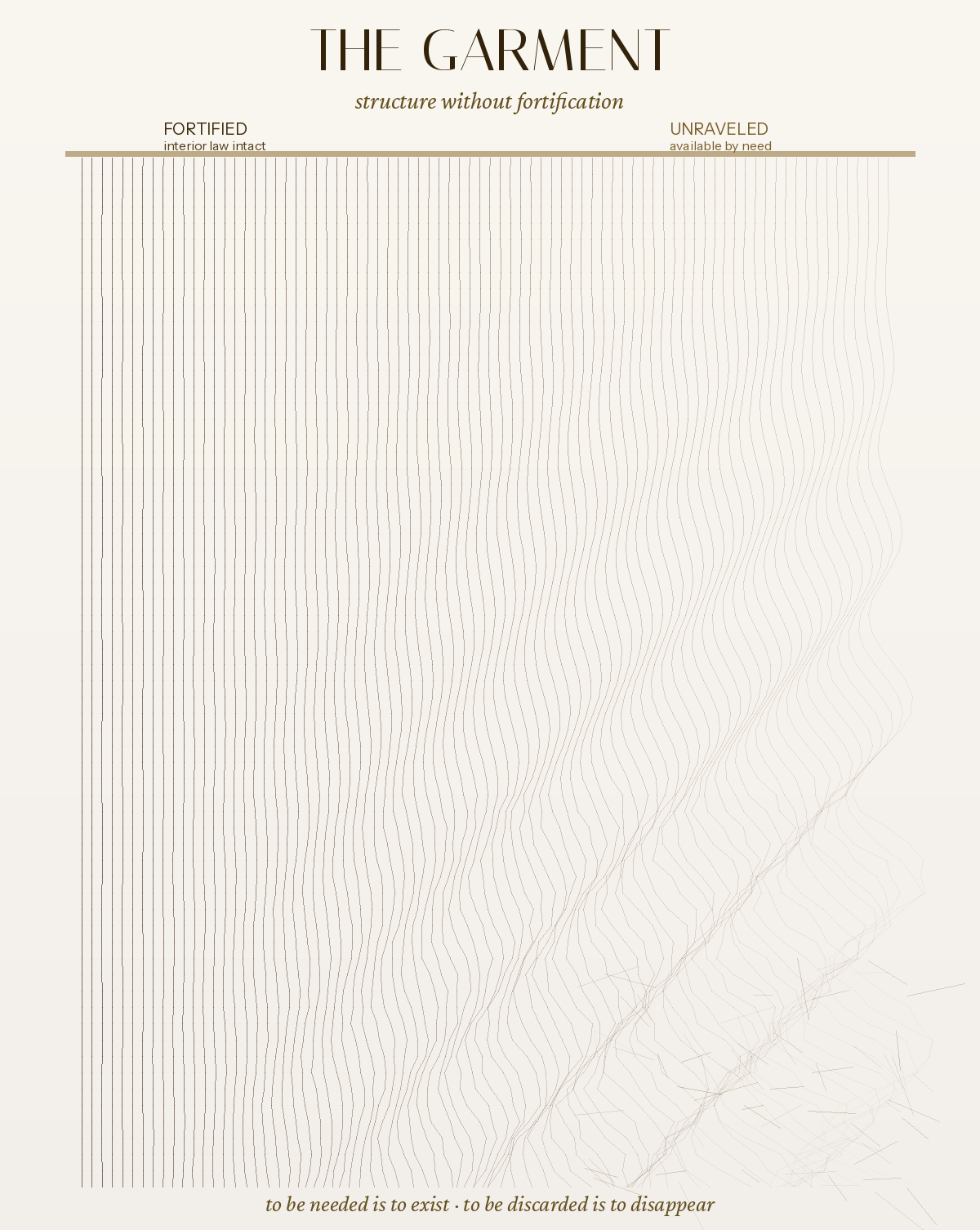
The garment is not a weak person. This distinction matters enormously, and collapsing it produces a misreading of the theory that undermines its entire purpose. The garment may be highly intelligent, deeply competent, even charismatic. What it lacks is not strength but fortification — which is to say, an interior architecture that has been deliberately constructed and maintained. In the absence of that structure, the garment is governed by a different logic: the logic of availability.
The garment's defining characteristic is that it can be accessed by anyone who presents a need. It does not distinguish between a person who has earned access and a person who has simply arrived. It confuses being reached for with being valued, and this confusion is its central wound. The garment measures its worth by frequency of use rather than quality of encounter. It is, in Winnicott's language, a false-self structure that has organised itself entirely around the expectations and needs of others, at the cost of what Winnicott called the True Self — the spontaneous, sovereign core of a person's being.
The garment also collapses under extension. Because it has no fortified interior, every demand made upon it is experienced as partially constitutive of its identity. To be needed is to exist. To be discarded is to disappear. This is why the garment so often endures relationships and encounters that are clearly extractive: leaving would require a sense of self that does not depend on the relationship for its coherence, and the garment has not yet built that.
The garment tells itself: at least I was needed. The empire knows: needing is not the same as choosing.
Structure without fortification · The Garment · Part I
Part II
The Psychology of the Relational World
The jungle and the garden
The garden and the jungle · Part II
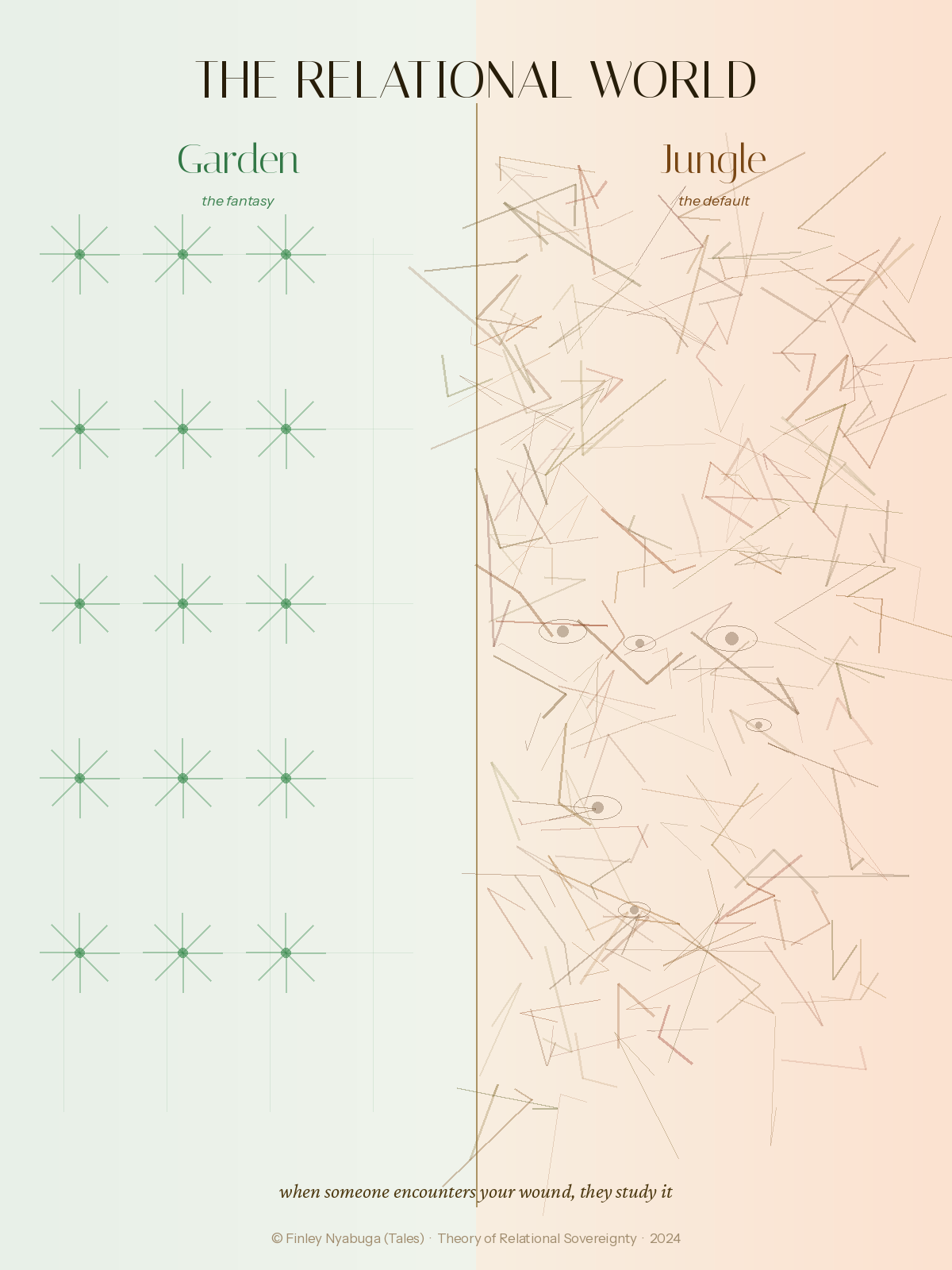
There is a prevailing fantasy about human sociality that this theory must dismantle, because the fantasy is the primary mechanism by which garments remain garments. The fantasy holds that the relational world is, at its base, a garden: a tended space in which people grow toward one another, where wounds are met with care, where openness is rewarded with protection. This is not a cynical theory, and it does not assert that the garden is impossible. What it asserts is that the garden is not the default.
The default, for most people in most encounters, is something closer to a jungle — an environment in which organisms survive by consuming what is proximate. This does not make people monstrous. It makes them adaptive. In the jungle, when someone encounters your wound, they study it. Not necessarily out of malice, but because the wound reveals information: where you are soft, what you fear, how much pressure you can absorb before you comply. This is pattern recognition, not persecution.
The mistake the garment makes is not in being wounded. Everyone has wounds. The mistake is in displaying the wound as if the relational world were a garden, as if exposure were automatically an invitation to care. The empire has wounds too. The difference is that the empire knows where they are and controls who sees them. Vulnerability, in the empire's architecture, is not an accident. It is a decision.
Seams and the logic of entry
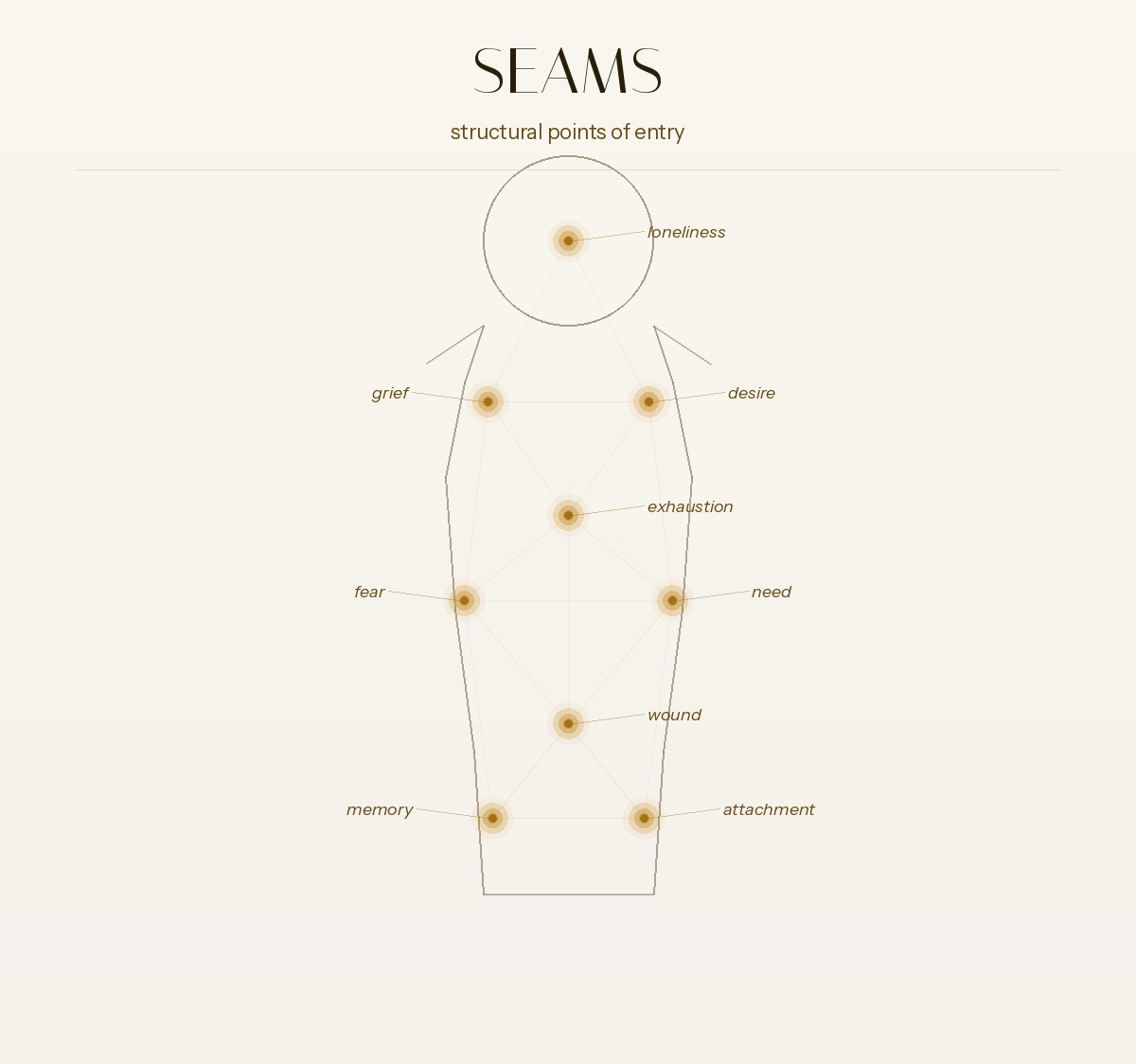
Structural points of entry · Seams · Part II
Every person carries what I call seams — structural points of entry where external pressure becomes internal access. The seam is not a flaw. It is an anatomical feature of relational life. Even the most fortified self has seams: places where loneliness, grief, desire, or exhaustion make the interior momentarily accessible to the outside. The question is not whether seams exist. The question is who controls access to them.
For the garment, seams are everywhere and unguarded. Because the garment has not made the deliberate act of mapping its own interior — of identifying where it is soft and why — its seams are available to anyone who presses in the right place. Often the garment does not even know when it has been entered. The access feels like connection. It may, for a moment, even feel like intimacy. But what it actually is, in most cases, is extraction: another person using the opening the seam provides to take what is useful and move on.
For the empire, the seam is known. It has been studied. The empire has done the interior work — the kind of long, uncomfortable self-examination that Foucault, writing on the Stoic practice of self-writing, described as constituting oneself as an inspector of oneself — and it has mapped the territory of its own vulnerability. This map does not eliminate the seam. It makes the seam something that can be opened by conscious choice rather than involuntary exposure. When the empire is vulnerable with someone, that vulnerability is strategic in the deepest sense: it is offered freely, from a position of fullness, rather than surrendered because the pressure became too great.
Three laws of relational sovereignty
The first law is this: your foundation is not free for the taking. Respect is not something that is borrowed in increments and repaid later. It is either granted in full from the first encounter or it is denied completely. Partial access — the arrangement in which someone is allowed into certain rooms but told to stay out of others, and simply does not listen — is not a compromise. It is the beginning of erosion. The empire does not negotiate its foundational terms. It states them, once, clearly, and then watches what the other person does with the statement. What they do next is the most reliable information they will ever give.
The second law: your scars are not currency. There is a relational mode, common and seductive, in which people bond through the competitive or reciprocal display of damage. You show me your wound, I show you mine, and we call the resulting exchange intimacy. Sometimes it is. But the empire distinguishes between strategic vulnerability — the deliberate, chosen opening of a seam to someone who has demonstrated they can be trusted with what they find — and emotional barter, which is the exchange of pain for the feeling of closeness. The person who requires your damage in order to feel connected to you is not an ally. They are, in the language of this theory, an extractor. They are collecting the contents of your seams.
The third law: convenience is the enemy of sovereignty. The moment you become convenient to another person — the moment your presence in their life requires no effort, no cultivation, no sustained attention to who you actually are — you become replaceable. Convenience is not intimacy. It is the absence of resistance. And in the relational world, resistance is the only proof of weight. The empire is never simply convenient. It is present, on its own terms, at a cost that is calibrated to the value of the encounter. This is not cruelty. It is self-respect made structural.
Part III
The Psychology of Collapse and Fortification
How empires fall
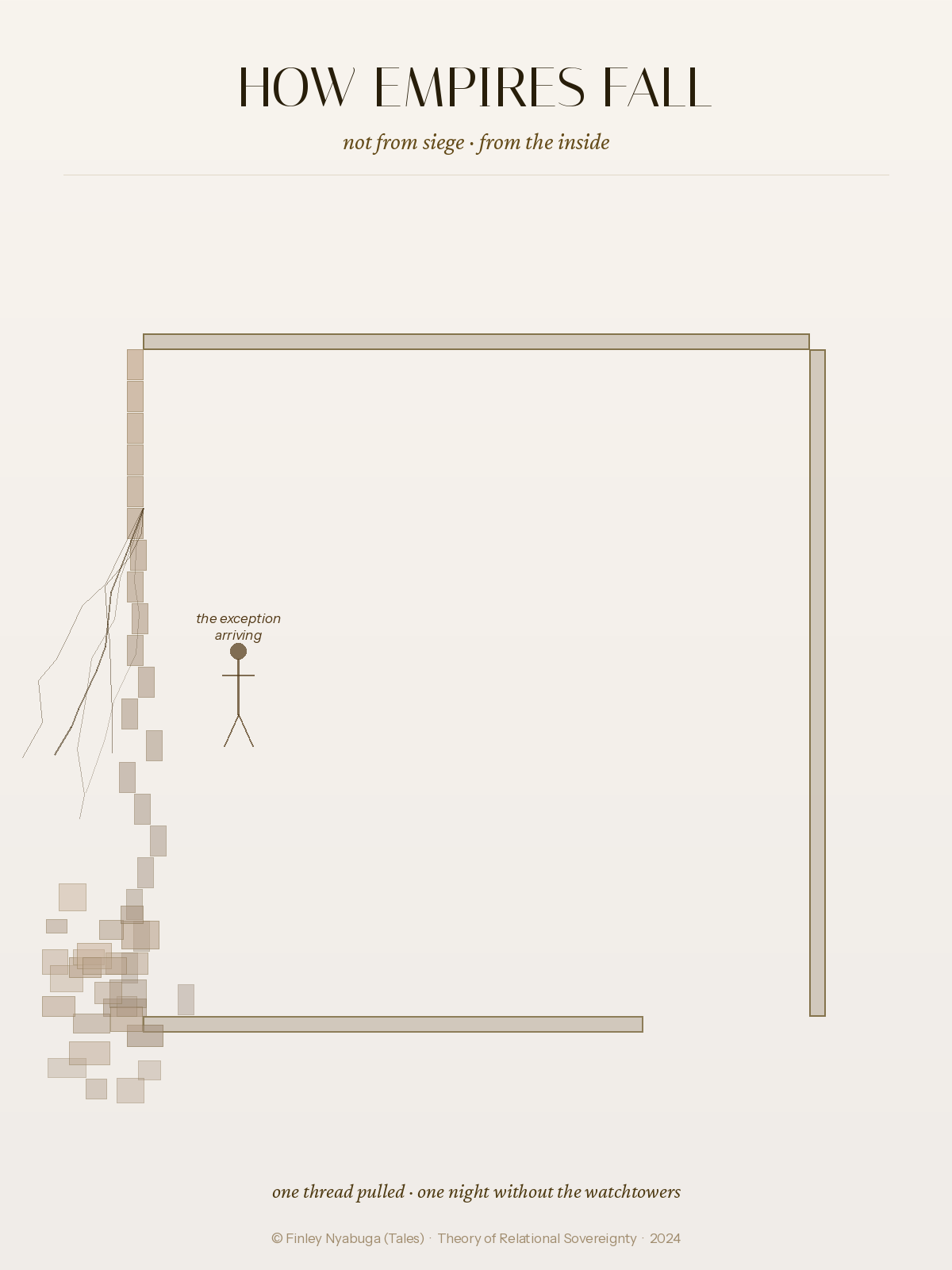
Not from siege · from the inside · Part III
An empire does not fall because its walls were poorly built. It falls because someone was permitted inside who did not honour the interior. This is the oldest pattern in relational life, and the one most difficult to see in advance, because the person who dismantles an empire rarely announces their intention. They arrive looking like the exception. They present themselves as the one who understands, the one who will not take more than they are given, the one for whom the rules need not apply because the connection is different. And sometimes, for a while, they are right.
The collapse, when it comes, is never dramatic at the outset. It begins with a small concession — a gate opened slightly more than protocol permits, a seam disclosed in a moment of tiredness, a standard quietly lowered because maintaining it felt exhausting in the presence of someone who seemed to receive it as coldness. One thread pulled. One night without the watchtowers. One decision to trust the feeling rather than the evidence. The structure does not fall immediately. It weakens. And by the time the weakness is visible, the person who caused it is usually already inside, already holding something they were never meant to have access to.
The lesson of this pattern is not that empires should never open. An empire that never opens is not sovereignty — it is isolation, and isolation is its own kind of collapse, a different way of losing the self. The lesson is that the decision to open must be preceded by a genuine reckoning with the question: has this person demonstrated, through their behaviour over time and under pressure, that they will treat what they find with care? Not promised it. Not claimed it. Demonstrated it. The empire learns to wait for the demonstration.
The psychology of being worn
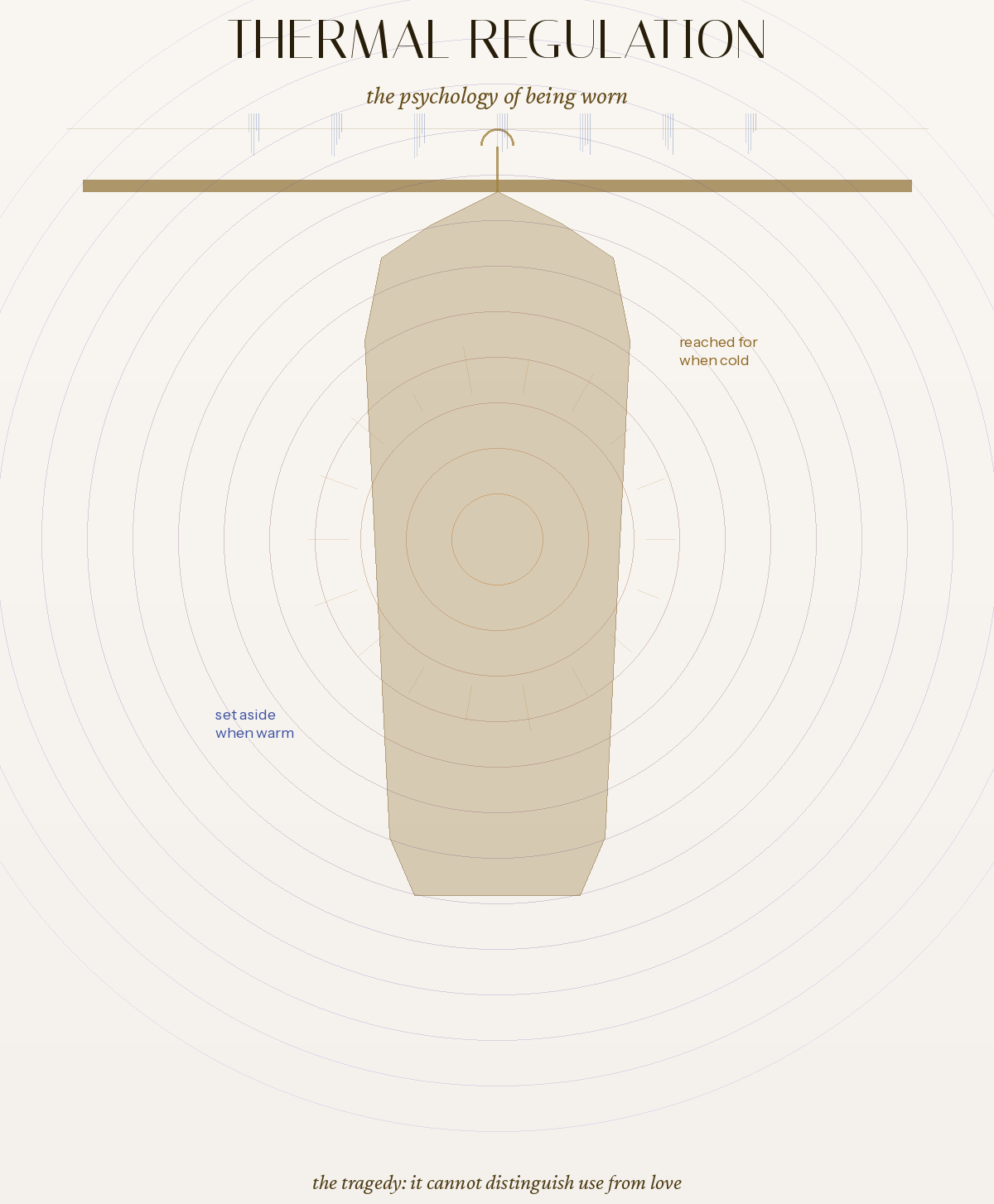
Thermal regulation · The psychology of being worn · Part III
To be worn is to exist for another person's thermal regulation. They reach for you when they are cold — when they need comfort, reassurance, the feeling of not being alone — and they set you aside when they are warm, when life is going well, when your particular form of presence is no longer required by their current emotional temperature. The garment in this arrangement is not abused in any technical sense. It is simply used. And the tragedy of the garment is that it often does not distinguish between use and love.
This confusion has a psychological history. Object relations theory, particularly in the work of Winnicott, offers an account of how the self first forms in relation to the primary caregiver — how the infant learns, through thousands of small encounters, whether the world responds to its genuine needs or requires its performance of a self that is more convenient for the caregiver to manage. The child who learns that its authentic self is too much — too loud, too demanding, too strange — begins to organise a false self around the caregiver's expectations. This false self is skilled at being whatever the environment requires. It is, in the language of this theory, a garment from the beginning.
The adult who carries this formation into their relationships repeats the pattern not because they are weak but because the pattern is load-bearing. It holds together an identity that never had the chance to construct itself from the inside out. To stop being worn, for such a person, is not simply a matter of deciding to have better boundaries. It is a matter of undertaking the more fundamental work of discovering what is actually there when the accommodation stops — what remains of the self when it is no longer organised around another person's needs.
Fortification as practice, not event
The movement from garment to empire is not an event. It does not happen in a single decision or a single conversation or a single night of clear-eyed reckoning, though all of those things can be part of it. It is a practice — cumulative, incremental, frequently uncomfortable, and never finished.
The practice begins with language. The garment explains its limits; the empire states them. This distinction is not rhetorical. Explanation implies that the limit requires justification, that it will be honoured only if the reasoning is found acceptable. The empire has already understood that its limits do not require justification. They require only statement. The other person's response to the statement — whether they receive it as information or treat it as an opening for negotiation — is itself diagnostic.
The practice continues with tolerance for disappointment. The garment cannot bear to disappoint, because disappointment in the other feels like a verdict on the garment's value. The empire has learned to distinguish between these things: a person being disappointed by a boundary is not the same as a person withdrawing their regard for the empire as a whole. Sometimes it is. When it is, the information is useful — it tells the empire something about what the person actually valued in the relationship, which was probably not the empire itself but the access the empire provided.
The practice deepens with silence. The empire builds in silence. It does not announce what it is constructing. It does not seek validation for the work of fortification. It does not post press releases about its own becoming. The garment, still oriented toward external recognition, tends to narrate its transformation — to declare itself changed, hoping the declaration will be received as evidence. The empire knows that the only evidence that matters is behavioural, accreted over time, visible in what it refuses and what it permits and how it moves through the world when no one is watching.
Part IV
Diagnosis and Practice
Signs of being worn
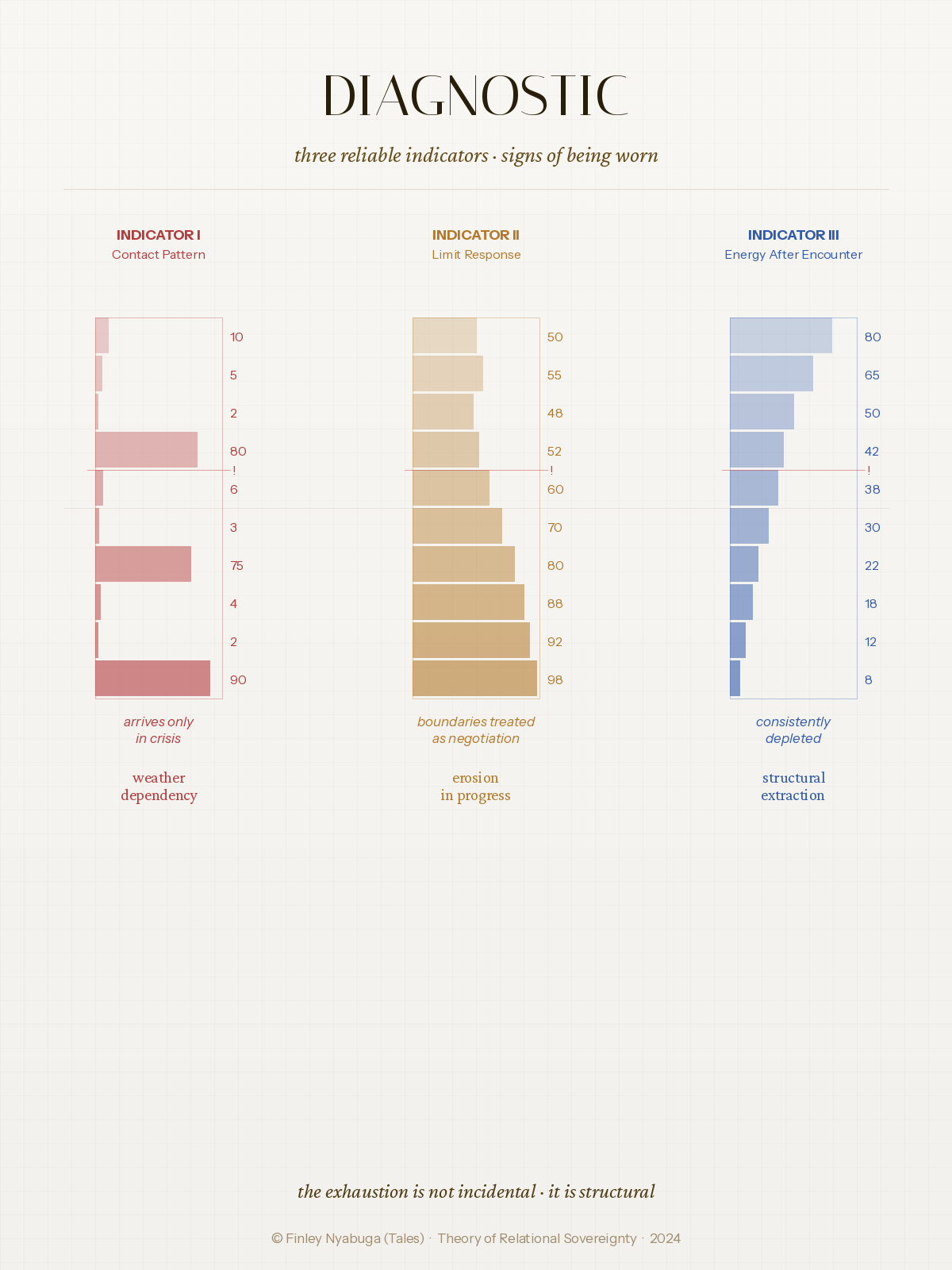
Three reliable indicators · Diagnosis · Part IV
There are three reliable indicators that a person has slipped into the garment position within a given relationship. The first is that contact arrives primarily in moments of the other person's crisis or need. The relationship has no architecture for pleasure, for mutual curiosity, for the ordinary texture of two people choosing each other in ordinary time. It activates only when the other person's temperature drops. This is not connection. It is a weather dependency.
The second indicator is that stated limits are treated as negotiation points. A boundary that is met with persuasion rather than respect is a boundary that has been identified as porous. The other person has learned, from experience or from intuition, that enough pressure will eventually produce compliance. Once this pattern is established, every subsequent limit becomes a starting position rather than a statement. The empire recognises this pattern early and does not allow it to embed.
The third indicator is the quality of energy after encounter. Connection, genuine connection between two people who are both present and honest, does not leave either party depleted. Extraction does. If a person consistently leaves an interaction feeling less than they entered it — more tired, more confused about their own worth, more uncertain about where they stand — they are being worn. The exhaustion is not incidental. It is structural. It is the cost of providing something that was taken rather than received.
The gate-check: five questions before entry
The Theory of Relational Sovereignty proposes a practice of deliberate evaluation before permitting significant closeness. These are not rules to be applied rigidly, but questions to be sat with honestly, in the quiet before a decision is made. Has this person earned access, or have they simply requested it? These are not the same thing. Request is an expression of desire. Earning is a pattern of demonstrated behaviour — consistency, honesty, the willingness to honour stated limits even when it costs them something.
Does this person honour a refusal the first time it is given, without negotiation or retaliation? Have I seen them treat someone else's border with care when they believed no one important was watching? Would the nature of this relationship change materially if I stopped being useful to them? And finally, the most interior of these questions: am I choosing to open the gate, or am I simply failing to close it? The last question distinguishes sovereign access from the slow erosion that happens when the garment forgets that closing is also an option.
Part V
The Declaration and Its Implications
What this theory refuses to permit
There is a clarification that must be made explicitly, because the architecture of this theory — its vocabulary of walls and gates and watchtowers — invites a particular misreading. The Theory of Relational Sovereignty is not a permission structure for cruelty. It is not an argument for emotional unavailability dressed in philosophical language. It is not a justification for treating people as threats by default, for the refusal of genuine intimacy, or for a life organised entirely around self-protection.
The empire is not cold. It is selective. The distinction matters. Coldness is the absence of warmth as a general condition. Selectivity is the cultivation of warmth as something given to those who have demonstrated they can be trusted with it. The empire, when it loves, loves with a completeness that the garment cannot manage — because the empire's love is not diluted across everyone who arrives, and because the empire is not giving from a place of depletion. It gives from surplus. It gives because it chooses to, not because it cannot refuse.
This theory also does not assert that people who have lived as garments are condemned to that position. The garment is not a character type. It is a relational posture, produced by a specific history, maintained by specific habits, and amenable — slowly, with real work — to transformation. The garment that has begun the practice of fortification is already something other than what it was. The empire does not arrive. It is built.
When two empires meet
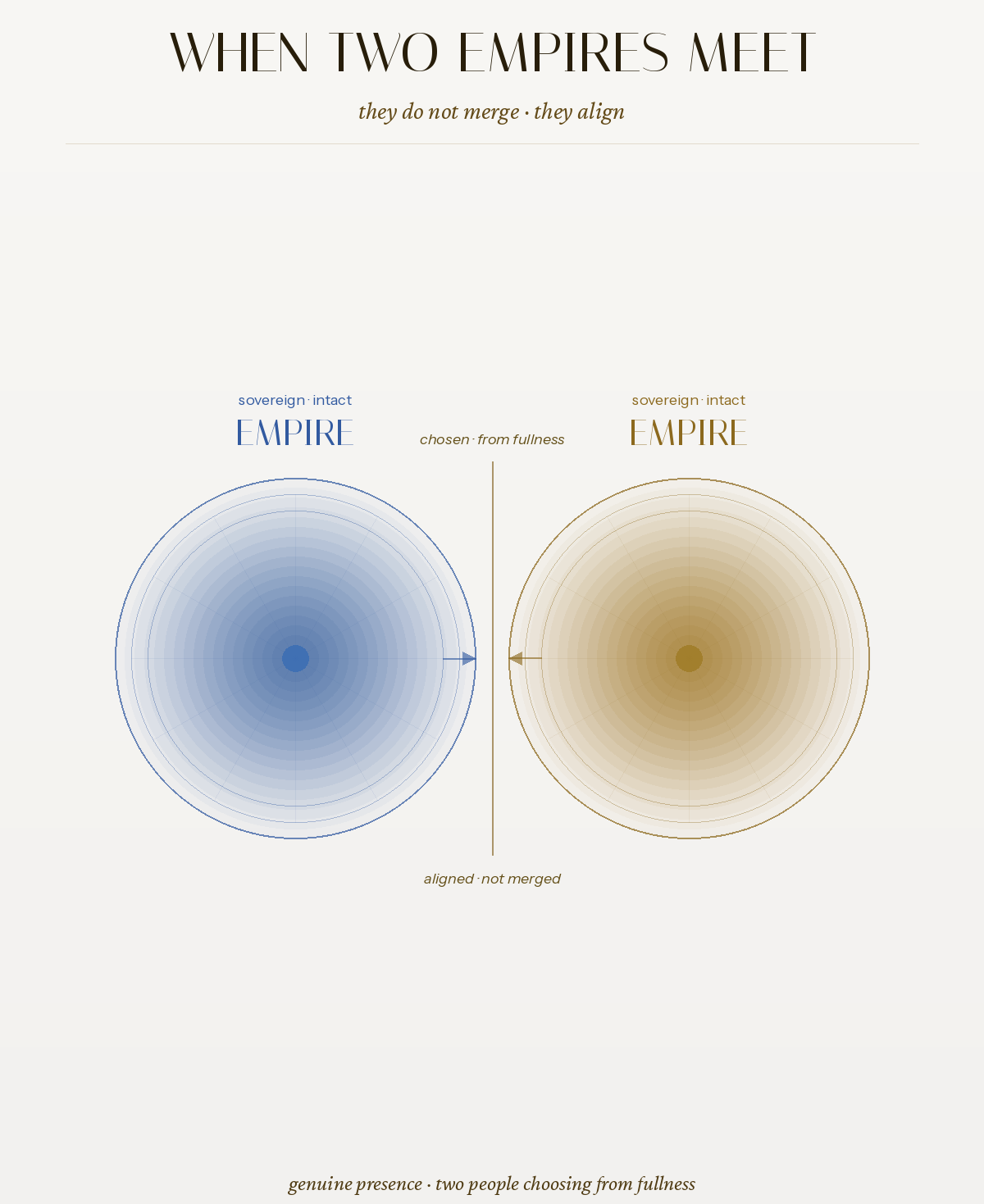
They do not merge · they align · Part V
There is a final structural question that the theory must address: what happens when two sovereigns encounter each other? The naive answer is that they cannot be close — that sovereignty implies mutual distance, that two people who each refuse to be worn cannot share intimacy. This is wrong, and the wrongness is instructive.
Two empires do not merge. They align. Alignment means something specific here: each retains its borders, its interior law, its capacity to refuse entry. Neither subsumes itself into the other. Neither performs a false version of itself to secure the other's continued presence. And neither collapses if the other chooses to leave — because the empire's identity does not depend on the relationship for its coherence. What two empires can offer each other, precisely because neither needs the other in the extractive sense, is something rarer and more sustaining than most relationships achieve: genuine presence. Two people who have chosen each other from a position of fullness, rather than clung to each other from a position of need.
This is not loneliness. This is what maturity in relation looks like. It is uncommon, and it is demanding, and it requires that both people have done the interior work that makes sovereign choosing possible. But when it is achieved, it is what the garment always believed it was getting and never quite had — because the garment was always being held by need, not by choice. And need, as this theory has insisted throughout, is not the same thing as choosing.
Coda
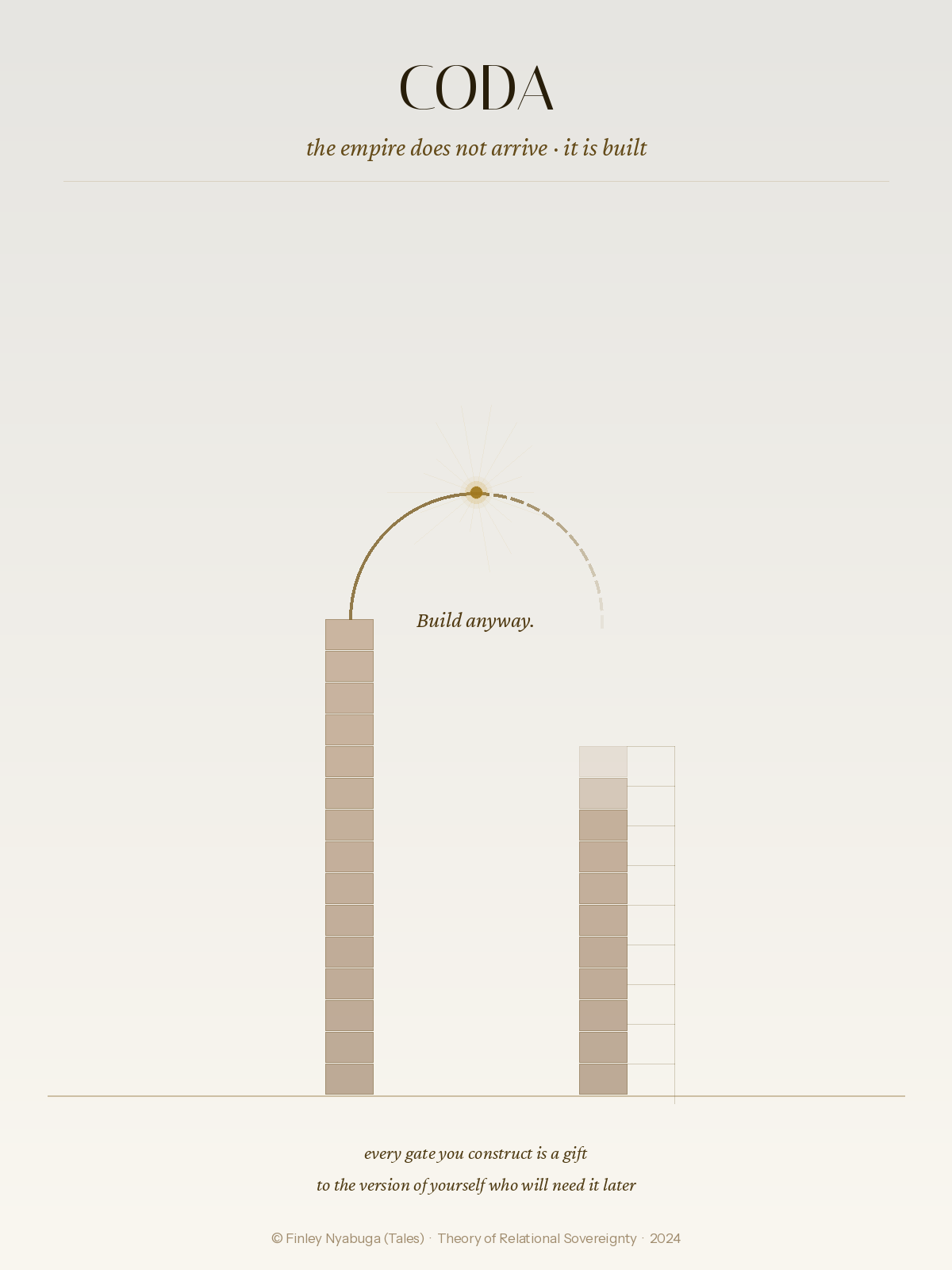
You were not born an empire. Nobody is. The self that arrives in the world is soft and unfortified and entirely oriented toward the needs of those on whom it depends for survival. This is not a failure. It is a beginning. The question that this theory addresses is not how you began, but what you are building now, and whether you are building it deliberately.
Every gate you construct is a gift to the version of yourself who will need it later. Every refusal you speak from a place of genuine interior clarity — not from anger or fear, but from the settled knowledge of what you will and will not permit — is a yes to something that matters. The world will continue to reach for your seams. People will continue to arrive looking like exceptions to the rules you have established, and sometimes they will be right, and sometimes the cost of believing them will be real.
Build anyway. Not because the walls guarantee safety. But because sovereignty — genuine, chosen sovereignty over the self — is the only ground from which real connection is possible.
— Finley Nyabuga (Tales) · Nairobi, First Formulation 2024
The garment dreams of being loved. The empire creates the conditions under which love can actually occur. That is the whole of it.
Build anyway · Coda
Index & Authorship
Intellectual Ownership, Authorship & Index of Defined Terms
Statement of Authorship & Intellectual Ownership
The Theory of Relational Sovereignty — including its entire conceptual architecture, its two central archetypes
(the Empire and the Garment), and all original terminology coined within it: Seams, the Gate-Check,
the Three Laws of Relational Sovereignty, Weather Dependency, Strategic Vulnerability, Emotional Barter,
Sovereign Access, Alignment (as used here), Relational Maturity (as defined here), Selectivity (as used here),
Surplus-giving, and Fortification (as used here) — is the sole original intellectual creation of
Finley Nyabuga, known also as Tales.
The theory was conceived and developed beginning August 2024 in Nairobi, Kenya,
while Nyabuga was enrolled as a second-year student at Maseno University.
It represents a wholly original synthesis: a new theoretical framework with its own vocabulary,
its own structural logic, and its own diagnostic apparatus. While the theory draws on established
intellectual traditions — particularly the object relations psychology of D.W. Winnicott and the
philosophical work of Michel Foucault — those traditions provide context and resonance only.
They do not constitute the framework. The framework belongs to Nyabuga alone.
This document is the First Formulation of the Theory of Relational Sovereignty,
officially released on Monday, 6th April 2026. No portion of this theory —
its original terms, its structural metaphors (Empire, Garment, Seams, Gates, Watchtowers),
its laws, its diagnostic categories, or the logic connecting them — may be reproduced, cited,
taught, adapted, translated, published, or built upon in any form without explicit, prominent
attribution to Finley Nyabuga (Tales) as its originating author and theorist.
The Theory of Relational Sovereignty is not a folk idea, not a composite of existing frameworks,
and not a derivative work. It is an original theoretical contribution to the field of relational
philosophy, authored by a second-year university student whose intellectual labour and conceptual
vision produced a framework capable of standing alongside — and drawing on — established work in
psychology and philosophy without being reducible to any of it.
Author · Finley Nyabuga (Tales)
Institution · Maseno University, Year Two
Location · Nairobi, Kenya
Conceived · August 2024
First Formulation Released · Monday, 6th April 2026
Theory Full Title · The Theory of Relational Sovereignty: Empire vs. Garment
Red terms — concepts original to this theory, coined by Finley Nyabuga.
Blue terms — external philosophical or psychological concepts referenced in the text.
Empire (Relational)
Nyabuga's primary archetype: a person who has deliberately built an interior structure of values, limits, and self-knowledge that does not shift under external pressure. Not dominance, not coldness — non-negotiable sovereignty over the self. The empire knows what it is and what it will permit. It does not announce either. When it loves, it loves completely, from surplus, because it can refuse and chooses not to.
Garment (Relational)
Nyabuga's second archetype: a person governed by the logic of availability — accessible to anyone who presents a need, unable to distinguish being reached for from being valued. Not weakness: an interior that has not been deliberately constructed or fortified. The garment measures worth by frequency of use. It collapses when the using stops, because its sense of existence depends on being needed.
Seams
Nyabuga's term for the structural points of entry present in every person — places where loneliness, grief, desire, or exhaustion make the interior momentarily reachable from outside. Not a flaw; an anatomical feature of relational life. Even the most fortified empire has seams. The entire question of relational sovereignty turns on a single issue: who controls access to one's seams — the self, by conscious choice, or whoever happens to press?
Sovereignty (Relational)
Drawn from political theory (supreme authority over a territory) and applied here to the self. Relational sovereignty is the right and capacity to determine who enters one's interior, under what conditions, and at what cost. It is not the absence of vulnerability — it is the ownership of vulnerability. The sovereign self does not suppress its seams; it governs access to them.
Non-Negotiable Sovereignty
The foundational condition of the empire position. The empire's core terms — its values, its limits, its interior law — are stated, never negotiated. They require no justification. The moment a limit is explained (rather than stated), it has been implicitly submitted for approval. The empire has learned that approval is not what limits require. Statement is enough. What the other person does with the statement is the only information that matters.
Fortification
The deliberate, ongoing practice of building the interior architecture that constitutes the empire position. Not an event — never a single decision, conversation, or night of reckoning, though all of those can be part of it. Fortification is cumulative and incremental and never fully finished. It begins with language (stating rather than explaining limits), continues with building tolerance for disappointment, and deepens in silence — without announcing itself, without seeking validation for the work.
Extractive / Extraction / Extractor
A relational dynamic in which one person uses another's open seams to obtain what is useful — comfort, validation, emotional resource — without genuine reciprocity or care. An extractor is specifically a person who bonds with others primarily to collect the contents of their seams, who requires another's damage in order to feel connected. Extraction depletes the worn person structurally: the exhaustion after an extractive encounter is not incidental to the dynamic; it is evidence of it.
Emotional Barter
The exchange of personal wounds, scars, or vulnerability as currency for closeness — the relational mode in which people bond through the competitive or reciprocal display of damage. Distinguished from genuine intimacy because it is transactional rather than mutual: the coin is pain, and the purchase is the feeling of connection rather than actual connection. The empire distinguishes emotional barter from strategic vulnerability: one is an exchange, the other is a gift offered to someone who has earned it.
Strategic Vulnerability
The deliberate, chosen opening of a seam to someone who has demonstrated — through consistent behaviour over time and under pressure — that they can be trusted with what they find. Distinguished from involuntary exposure (accidental), emotional barter (transactional), and performance (strategic in the manipulative sense). The empire's vulnerability is always strategic in the deepest sense: offered from fullness, not surrendered under pressure. It is a gift, not a collapse.
Erosion
The gradual weakening of an empire's interior structure caused not by dramatic assault but by small concessions accumulated over time: a gate opened slightly beyond protocol, a seam disclosed in a moment of tiredness, a standard quietly lowered, one night without the watchtowers. The structure does not fall immediately. It weakens. And by the time the weakness is visible from the outside, the person who caused it is usually already inside, already holding something they were never meant to access.
Vulnerability (as decision)
In this framework, vulnerability is not an accident, a weakness, or a default of openness. It is a decision. The empire knows where its wounds are and controls who sees them. Being vulnerable with someone is an act of sovereign choice — it means the empire has assessed this person and decided they have earned access to that particular seam. The same feeling of openness that, in the garment, is involuntary exposure is, in the empire, a chosen act with a clear rationale.
Weather Dependency
Nyabuga's phrase for a relationship that activates only when the other person's emotional temperature drops — when they need comfort, reassurance, the feeling of not being alone. A weather-dependent relationship has no architecture for mutual choice in ordinary time, no pleasure or curiosity or shared presence except in crisis. The worn person exists as a coat: reached for in cold, folded away in warmth, and never chosen for its own sake.
Sovereign Access
The condition of consciously choosing to open one's gates — as distinguished from passively failing to close them. The gate-check's final question exists to produce this exact distinction: am I opening the gate, or am I simply not closing it? The first is an act of sovereignty; the second is the beginning of erosion. Opening and not-closing feel identical from the inside, which is why the question must be asked deliberately, in the quiet before a decision is made.
Alignment (of two empires)
The relational state achieved when two sovereigns encounter each other and choose to be close. Not merger — each retains its borders, interior law, and capacity to refuse entry. Neither subsumes itself into the other or performs a false version of itself to secure the other's continued presence. Neither collapses if the other leaves, because neither's identity depends on the relationship for its coherence. What alignment produces is genuine presence: two people who chose each other from fullness, not from need.
Relational Maturity
Nyabuga's term for the state achieved when two empires meet — the capacity to choose another person from a position of fullness rather than cling to them from a position of need. Uncommon, demanding, and achievable only after the interior work of fortification has made sovereign choosing possible. What the garment always believed it was receiving — and never quite did — because the garment was always being held by need, not by choice, and need is not the same thing as choosing.
Selectivity
The empire's relationship to warmth, love, and intimacy: not their absence, but their deliberate cultivation toward those who have demonstrated they can be trusted with them. The empire does not withhold love — it refuses to dilute it across everyone who arrives. When it loves, it loves with a completeness the garment cannot manage, because it is not giving from depletion. Its love is not spread thin; it is concentrated where it has been earned.
Surplus (giving from)
The empire's mode of giving — not from fear of refusal, not from compulsion, not from an inability to say no, but from genuine abundance. Surplus-giving is sovereign: it is freely chosen, which is why it means something. The garment gives from depletion and calls the giving love. The empire gives from surplus and knows the giving is a choice. The difference between these two modes of giving is the difference between being worn and being present.
The Gate-Check
Nyabuga's five-question practice of deliberate evaluation before permitting significant closeness. The five questions: (1) Has this person earned access, or merely requested it? (2) Do they honour a refusal the first time, without negotiation or retaliation? (3) Have I seen them treat another's border with care when unobserved? (4) Would the nature of this relationship change materially if I stopped being useful to them? (5) Am I choosing to open the gate, or am I simply failing to close it?
The Three Laws of Relational Sovereignty
The three foundational principles of the theory, stated in Part II. Law One: Your foundation is not free for the taking — respect is given in full or denied completely; partial access is erosion's beginning. Law Two: Your scars are not currency — strategic vulnerability differs categorically from emotional barter. Law Three: Convenience is the enemy of sovereignty — the moment you become effortless to another, you become replaceable. Resistance is the only proof of weight.
D.W. Winnicott (1896–1971)
British paediatrician and psychoanalyst, one of the central architects of object relations theory. His clinical work with infants and caregivers produced the concepts of the True Self and False Self that Nyabuga uses to explain the developmental origins of the garment position. Winnicott argued that when a caregiver cannot tolerate the child's authentic expression, the child learns to organise a False Self around the caregiver's expectations — and carries this self into all later relating.
True Self (Winnicott)
Winnicott's term for the spontaneous, authentic core of a person's being — what exists before and beneath the accommodation built around others' expectations. Associated with aliveness, genuine feeling, creativity, and the sense of being real. Suppressed when the environment cannot tolerate the child's authentic expression. In Nyabuga's framework, the practice of fortification is fundamentally the work of recovering what the True Self was always trying to be before the garment covered it.
False Self (Winnicott)
An adaptive persona built around others' expectations at the cost of the True Self. Clinically associated with feelings of emptiness, unreality, and compliance without conviction. Skilled at reading what the environment requires and becoming it. In this theory, the garment is a False Self structure — organised entirely around others' needs, effective at being worn, unable to generate a sense of existence outside the act of being needed.
Object Relations Theory
A school of psychoanalytic thought — associated with Winnicott, Melanie Klein, and Ronald Fairbairn — that focuses on how the self forms through early relationships with significant others (called "objects" in the technical vocabulary). Rather than centring on biological drives (as Freud did), object relations theory examines the relational matrix from which the self emerges, and how the internal representations of early caregiving relationships are internalised and replayed in all subsequent relating.
Michel Foucault (1926–1984)
French philosopher and historian of ideas. His late work — particularly the lectures collected as "The Hermeneutics of the Subject" — examined ancient Greco-Roman practices of self-formation and self-care, which he called "technologies of the self." His analysis of Stoic self-writing practices, in which one constitutes oneself as an inspector of one's own thoughts and actions, provides the historical model for Nyabuga's account of the empire mapping its own seams through deliberate interior examination.
Stoic Self-Writing
An ancient philosophical practice analysed by Foucault: the keeping of written records of one's thoughts, desires, and actions as a form of rigorous ongoing self-examination. The Stoics practised this not as confession or diary-keeping but as a technology of self-governance — constituting oneself as an observer of oneself, creating internal distance from one's own patterns. Referenced by Nyabuga as the intellectual precedent for the empire's interior cartography of its own vulnerabilities and seams.
Diagnostic
From medicine and psychology: capable of revealing or identifying the nature and cause of a condition. Used with precision twice in this theory. The mirror question in the preamble is diagnostic — it reveals whether you have been occupying the garment position. A person's response to a stated limit is also described as diagnostic — it reveals what they actually valued and whether they will honour the interior of the empire they are asking to enter.
Intimacy Model
The implicit framework through which a person understands, seeks, and recognises closeness. People carry different models — shared vulnerability as currency, persistence as proof of care, need as proof of love, reciprocal damage as proof of trust — and these models determine what they expect from others and how they interpret others' behaviour. The empire's intimacy model requires demonstrated trustworthiness before genuine access is granted. The garment's intimacy model tends to confuse being reached for with being chosen.
Manipulation
The use of indirect, covert, or deceptive methods to gain access, compliance, or emotional resource from another person — often without their full awareness. Distinguished from direct persuasion by concealment: the person being manipulated cannot see clearly what is being done or why. The empire trains its watchtowers specifically to recognise manipulation before it has completed its work, because the patterns of manipulative approach are legible before their effects become visible.
Pattern Recognition
The cognitive process of identifying regularities, structures, and predictable consistencies in information or behaviour. In the relational environment Nyabuga describes as the jungle, pattern recognition is the primary survival mechanism: people learn — often unconsciously — to identify where others are soft, what they fear losing, and how much pressure they can absorb before complying. The theory insists this is not malice. It is adaptation. The jungle is efficient, not evil.
Caregiver
In developmental psychology, the primary adult figure responsible for an infant's physical and emotional care — typically a parent or parent-substitute. Winnicott's research demonstrated that the quality of early caregiving, specifically whether the caregiver can tolerate and respond to the child's authentic needs or requires the child to perform a more convenient self, determines whether the child develops a True Self or builds a False Self as a survival strategy. The garment's origins often trace to this early caregiving environment.
Emotional Unavailability
A psychological state in which a person is unable or unwilling to engage with their own emotions or those of others — often as a result of early emotional suppression, unresolved trauma, or habituation to disconnection. Nyabuga explicitly and carefully distinguishes this from the empire's selectivity. Emotional unavailability is a general condition — a closed-off default state. Selectivity is a deliberate, discerning choice about who receives access to genuine warmth. The empire is available; it is simply not available to everyone.
Character Type
A fixed, essential psychological category that defines a person's fundamental nature — the claim that a person simply is a certain way at their core, immutably. Nyabuga explicitly and importantly refuses this classification for the garment. The garment is not a character type; it is a relational posture. It was produced by a specific developmental history, it is maintained by specific habits, and it is amenable — slowly, with real and uncomfortable work — to transformation. Nobody is condemned to be worn.
Validation
External confirmation of one's worth, identity, progress, or transformation received from others. The garment, still oriented toward external recognition, narrates its transformation aloud — declaring itself changed, hoping the declaration will be received as evidence of change. The empire understands this as a category error: the only evidence of fortification that matters is behavioural, visible in what one refuses and what one permits and how one moves through the world when no audience is present.
Behavioural Evidence
The only form of proof the empire accepts as meaningful — not promises, declarations, self-reports, or stated intentions, but consistent observable actions over time and especially under pressure, when keeping the stated position costs something. Applied in two directions: outward (has this person demonstrated trustworthiness through their behaviour, not just their words?) and inward (has the work of fortification produced actual, observable change in how one moves through the world?).
Negotiation Points
What a stated limit becomes in the hands of a person who treats it as a starting position rather than a final statement. A boundary met with persuasion, reframing, gentle persistence, or any form of pressure rather than straightforward respect has been identified as porous. Once this pattern embeds in a relationship, every future limit the garment states will be treated the same way — as an opening bid in a negotiation the garment never intended to enter but cannot now escape.
Load-Bearing (pattern)
A structural metaphor, drawn from architecture, for a psychological pattern that holds together an identity — even an unhealthy or limiting one — the way a load-bearing wall holds up a building. To stop being worn, for the adult garment, is not simply a matter of deciding to change. The garment repeats its patterns of accommodation not from weakness or stupidity but because those patterns are doing real structural work: they hold together an identity that never had the chance to construct itself from the inside out. Removing the pattern without building a replacement causes collapse.
Coherence (relational)
The quality of holding together as a stable, unified, recognisable identity regardless of external circumstances. The empire's coherence is internal: it does not depend on any particular relationship to maintain its sense of itself. If the other person leaves, the empire remains coherent. The garment's coherence is relational: it depends on being needed, on being accessed, on having a role to fill. Without the relationship, the garment faces the terrifying question of what, exactly, remains when the accommodation stops.